
Studio: Fleischer Studios (Color Classics)
Distributor: Paramount Pictures
Produced by: Max Fleischer
Short Synopsis
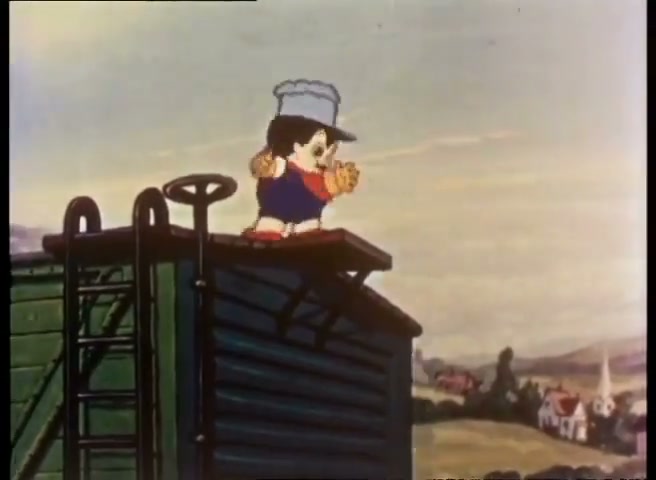
A small boy in an engineer's cap plays with a toy train in his back yard and dreams of driving a real one. A freight train stops beyond the gate. His St Bernard, Rover, drags him back the first time, so the boy ties the dog to a tree and climbs aboard the last boxcar. As the train moves he falls, strikes his head on the rail and is knocked out. In his dream he wakes in an enormous railway yard full of streamlined engines with uneasy smiling faces, boards a gleaming blue-green locomotive, and sets it going. It gathers speed; the gauges turn into faces that chant "play safe"; the levers vanish from his hands; the engine races through mountains and into a cavern toward disaster. In the real world another train is coming down the line toward the unconscious boy. Rover breaks his rope and reaches him in time, and the boy wakes in the dog's care, cured of his dream.
Why It Matters
- The nightmare railway, with its leering streamliners and faces in the dials, is one of the Fleischers' most striking dream sequences, closer to the surrealism of 1930 than to the gentle Color Classics around it, and the model-set yard, photographed in depth, gives the engines real bulk.
- The film is in the public domain in the United States, its copyright having lapsed, and it is a safety lecture, a Depression-era warning to children not to hop freights, made at the request of railway interests; its song by Vee Lawnhurst and Tot Seymour, a professional songwriting team, was published separately.
Notes and Trivia
- Freight-hopping by boys was a real social problem of the 1930s, the subject of the 1933 film Wild Boys of the Road.
- Streamlined locomotives like the one in the dream were the new marvels of 1936.
- See also: Hawaiian Birds (1936), Christmas Comes But Once a Year (1936), Mickey's Choo-Choo (1929).


