Studio: Soyuzmultfilm
Short Plot Synopsis
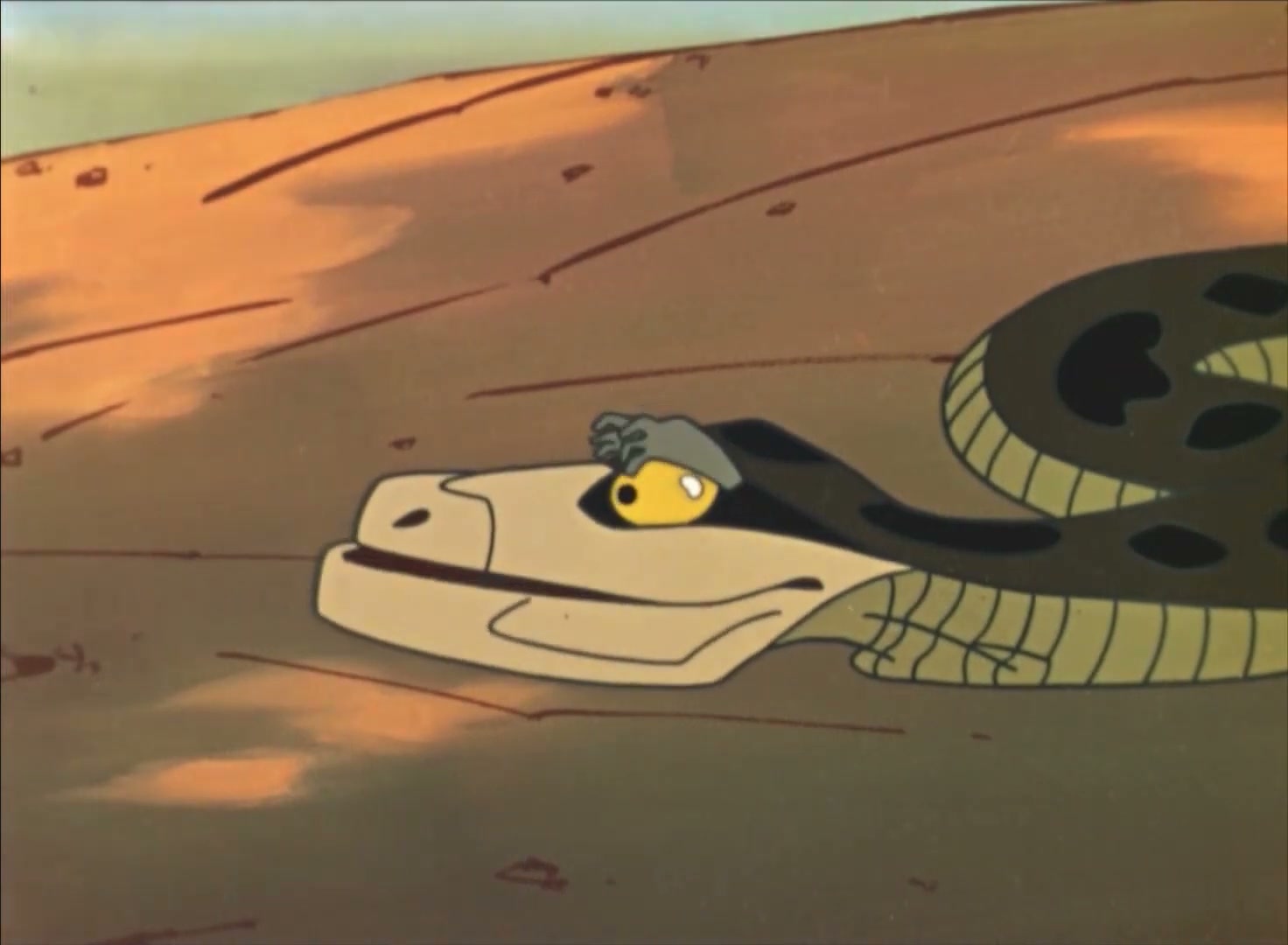
Mowgli. The Battle is the war chapter of Roman Davydov's Kipling cycle: the jungle boy and his animal allies face a full-scale assault that turns the serial into open combat rather than wandering adventure. As preserved in later summaries of the Soviet adaptation, the episode covers the struggle against the wild dogs and pushes Mowgli toward the brutal responsibilities of leadership and killing.
That matters because the installment is not just connective tissue inside a future feature assembly. It is the point where the cycle hardens from initiation story into battle narrative, with the jungle world organized around siege, counterattack, and survival.
Why Is It Worth Watching?
- It shows Davydov's
Mowgliproject at its most martial and severe, where the jungle becomes a battlefield rather than a storybook landscape. - It pairs Kipling combat material with Sofia Gubaidulina's score and the serial chapter form, giving the episode a weight very different from a one-off animal short.
- It helps explain why the Soviet
Mowglicycle remains distinct from softer, more domesticated Jungle Book adaptations.
Legacy And Impact
Mowgli. The Battle matters because later circulation often buries it inside the assembled Adventures of Mowgli, when in production terms it was one specific short chapter with its own credits, runtime, and dramatic function. Animator.ru's preserved episode page keeps that identity from dissolving completely by holding onto the 19-minute length and the Belokurov/Gubaidulina pairing specific to this installment.
Its legacy is therefore tied to serial form. Keeping the chapter visible shows how Soviet animation could spread a major literary adaptation across several short-film releases before later packaging made the whole project look like a single feature from the start.
Trivia
- Animator.ru preserves the episode as a 19-minute chapter with Leonid Belokurov and Sofia Gubaidulina credited specifically to this installment, which helps keep the original episodic release structure from dissolving completely into the later feature assembly.
- That preserved chapter record is much firmer on runtime than on exact release-day evidence, which is why the article stays at year precision while keeping the 19-minute figure.
- The entry's stronger runtime metadata is therefore intentional, not accidental: the chapter survives more cleanly as a timed unit than as a day-dated release event.
- That distinction is now explicit enough that later cleanup should treat the runtime/date split as settled rather than provisional.
- A fresh pass through the primary Russian animation database still only reinforces the episode identity and year-level placement, not a cleaner calendar date.
- On the current evidence, the entry should therefore be treated as metadata-stable at year precision unless stronger primary release documentation appears.
- A direct check of the linked Wikidata entity still returns only a year-precision release claim for 1970, even though the serialized value is written as
1970-01-01, so it still does not justify a real day-level move. - That chapter structure matters because Davydov's cycle sits on the border between theatrical short, serial narrative, and assembled feature, which is exactly why catalog records so often wobble between the part and the whole and why chapter titles need active preservation.
- It also shows how Soviet animation could stretch ambitious literary material across multiple release units without abandoning the short-film economy that originally produced it, which helps explain why the part-versus-whole catalog problem keeps returning.