
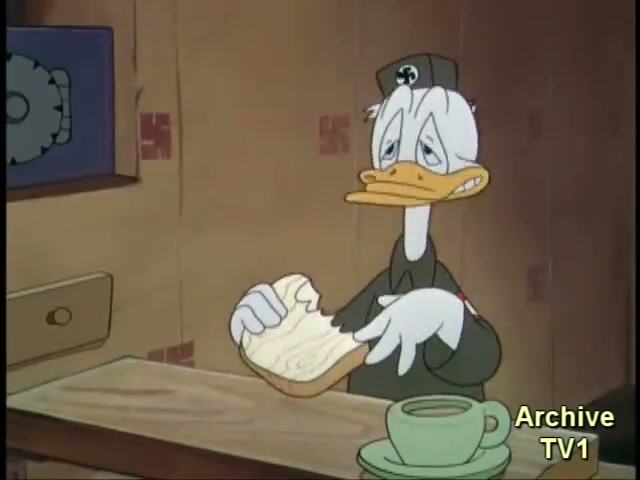
Studio: Walt Disney Productions, for the US Treasury Department
Distributor: RKO Radio Pictures
Produced by: Walt Disney
Short Synopsis
Donald Duck has just been paid, and two sides of his character appear to fight over the money. The thrifty duck is an old Scotsman in kilt and tam-o'-shanter who urges him to put the pay aside for the taxes due in March; the spendthrift is a zoot-suited hipster with a straw boater who wants him to blow it on "good dates". The Scot reminds Donald that the dates to remember are the ones on which his taxes fall due. The two pull Donald back and forth between a bank and a saloon until the spendthrift's doors turn into a swastika and the Scot's into stars and stripes, and Donald sees that one is a friend of Hitler and the other an American. The narrator asks whether the audience will spend for the Axis or save for taxes; Donald chooses to save. A montage, recycled from the previous year's The New Spirit, shows the taxes becoming planes, ships and shells and the shells falling on the enemy, to the opening bars of Beethoven's Fifth and the refrain "taxes to beat the Axis".
Why It Matters
- The thrifty Scottish duck is Carl Barks's first sketch of the character who became Scrooge McDuck in the comics four years later, which makes this six-minute tax commercial a footnote in the history of one of Disney's most durable characters; Ward Kimball's animation of the tug-of-war is quick and funny.
- The film was commissioned by the Treasury to persuade Americans to pay the new wartime income tax, as a sequel to The New Spirit, and although a Disney production made under contract is not automatically a government work, no renewal appears for it in the Catalog of Copyright Entries for 1969-72, so it is in the US public domain.
Notes and Trivia
- The New Spirit had been nominated for an Academy Award and criticised in Congress for its cost.
- The hipster duck's zoot suit dates the film to the months before the Los Angeles zoot suit riots.
- See also: Der Fuehrer's Face (1943), Education for Death (1943), The Home Front (Private Snafu, 1943).


