
Studio: The Charles Mintz Studio (Krazy Kat)
Distributor: Columbia Pictures
Produced by: Charles Mintz
Short Synopsis
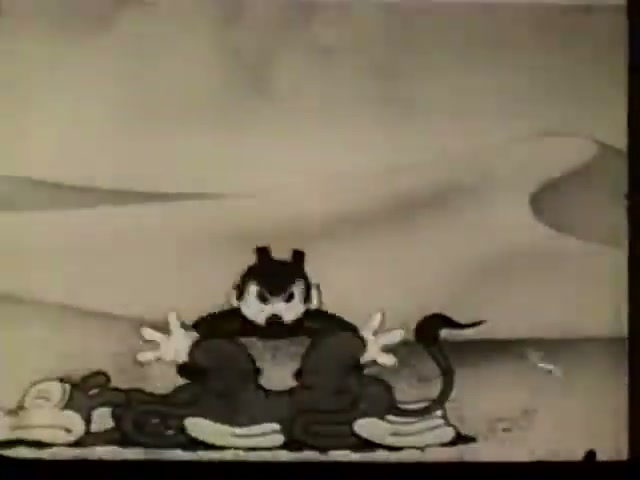
In a many-domed palace somewhere in the Middle East, a turbaned jackal watches the world in his crystal ball, and the ball lets him reach in and take what he sees. He spots Krazy Kat riding a camel with his girlfriend, a spaniel, kills the camel and snatches the girl. Krazy finds a spare camel inside the dead one, rides to the palace, drills past two hippopotamus guards and goes in after the jackal, who flees with the spaniel in a lift. The palace fights Krazy at every turn: a door crushes him flat and posts him through a hole that narrows, widens and twists; mummies try to club him; he is trapped in a glass clock with a giant knife, stung fat by a bee, floats up with the clock, is pecked back to size by two birds, and reaches the room where the jackal and the girl are, for the final confrontation and rescue.
Why It Matters
- It is the most hallucinatory cartoon in a series that was never short of strangeness: the swirling corridor, the knife clock and the inflating cat are the Mintz studio at its loosest, in the pre-Code manner that let anything happen as long as it kept moving. Preston Blair, later a Disney and MGM animator and the author of the standard animation textbook, is among the animators.
- The Mintz Krazy Kat series for Columbia ran from 1929 to 1940 and bore almost no relation to George Herriman's strip; Krazy was a generic cat in generic adventures. The Crystal Gazabo is one of its best, a small masterpiece of nonsense, and its title, the slang "gazabo" for a fellow, is usually misread as "gazebo".
Notes and Trivia
- The Mintz studio was the successor of Winkler Pictures, which had distributed Disney's Alice Comedies and taken Oswald from him.
- Herriman's Krazy Kat strip was still running in the Hearst papers while these cartoons were made.
- See also: Stomach Trouble (1927), Betty Boop, M.D. (1932).


