
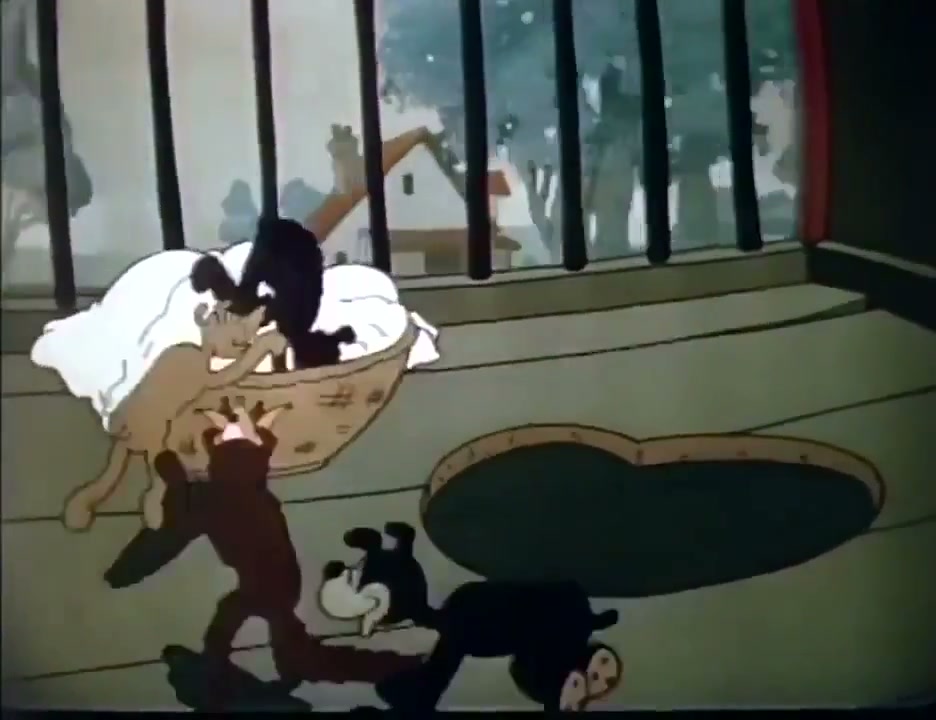
Studio: Ub Iwerks Studio (ComiColor Cartoons)
Distributor: Celebrity Productions
Produced by: Ub Iwerks
Short Synopsis
Old Mother Hubbard goes to the cupboard to get her poor dog a bone, and the cupboard is bare. The film follows the nursery rhyme's verses as a series of errands: she goes to the baker's to buy him bread, the undertaker's to buy him a coffin, the hatter's for a hat, the barber's for a wig, and each time she comes back the dog is doing something unexpected, dead and then laughing, dancing a jig, riding a goat, reading the news, feeding the cat, playing the flute. The dog's tricks escalate until the old woman, out of errands and out of patience, curtsies to him and he bows to her, as in the rhyme's last verse, and the film ends with the two of them dancing in the kitchen. The Wikipedia entry is a stub, and the account above follows the rhyme as the film illustrates it.
Why It Matters
- The rhyme is a list of non sequiturs, and Iwerks treats it as one, each verse a blackout gag with the dog as a vaudeville performer; the dog is a good character, a lanky mongrel with a comedian's timing, and the cumulative rhythm of errand and surprise is the film's whole method.
- The film is in the public domain in the United States, its copyright never renewed, and it has been among the most circulated ComiColors in cheap prints; it is also one of the last the studio made with Carl Stalling, who left for Warner Bros. in 1936 to score the Looney Tunes for the next twenty-two years.
Notes and Trivia
- The rhyme's "Old Mother Hubbard" was published in 1805 and is one of the earliest best-selling children's books.
- The dog's cross-dressing gag in the wig verse is a regular Iwerks touch.
- See also: The Bremen Town Musicians (1935), Summertime (1935), Simple Simon (1935).


