
Studio: Fleischer Studios
Distributor: Paramount Pictures
Produced by: Max Fleischer
Short Synopsis
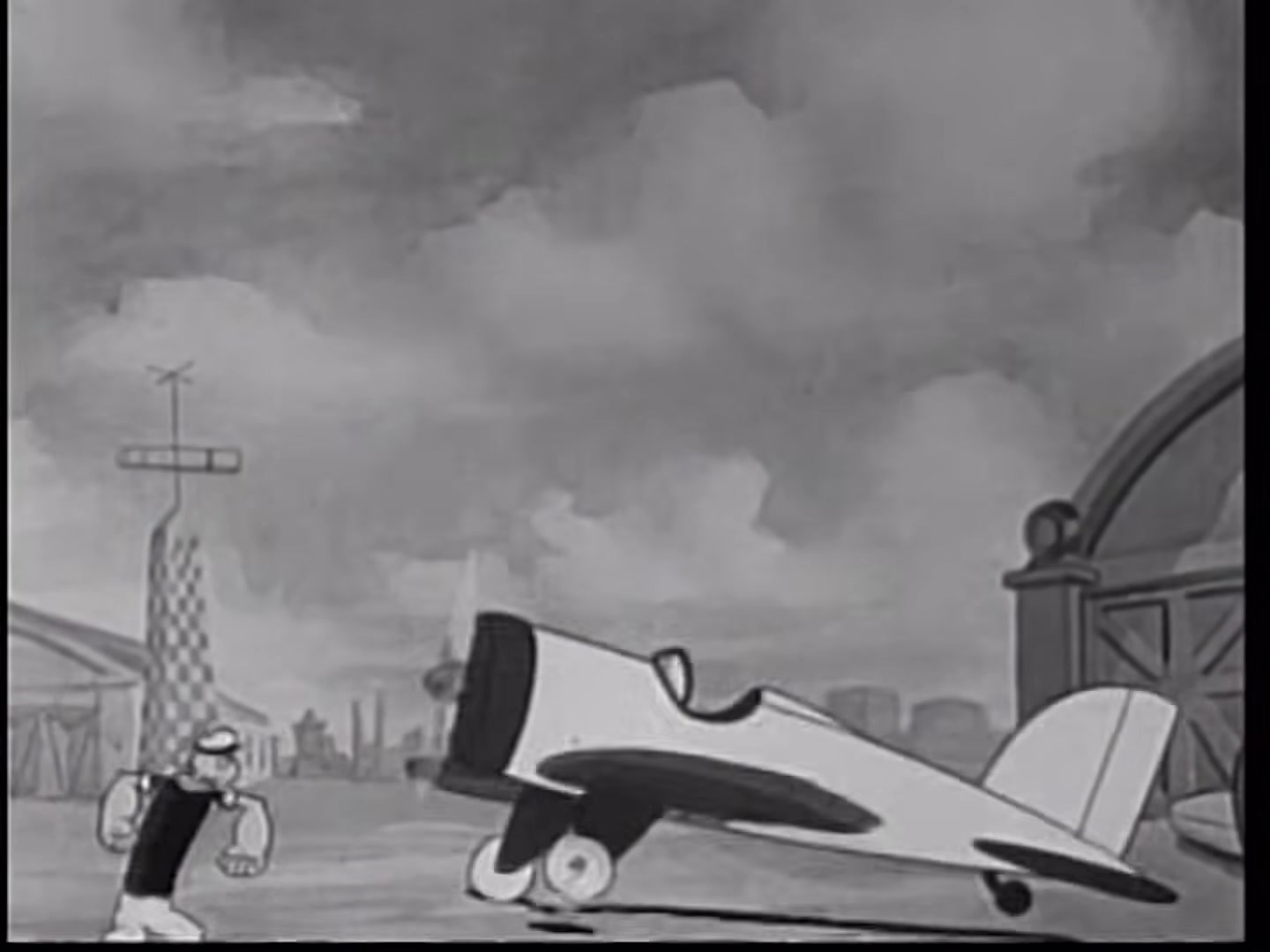
Olive Oyl has taken a job at an airfield, and the pilot Bluto makes a pass at her and bundles her into his plane. Popeye, arriving to find her gone, borrows another aircraft and goes after them with no idea how to fly it; the plane bucks, stalls and loops, and he hangs on. Bluto, enjoying himself, dives at Popeye and knocks him out of the sky, and the sailor falls, catching hold of a bird on the way down. He feeds the bird his spinach, and it swells into a creature strong enough to carry him back up to the fight. Popeye boards Bluto's plane in mid-air, the two slug it out on the wings and in the cockpit while Olive screams, and Popeye lands the plane, with Bluto wrapped around the propeller, to the sailor's closing song.
Why It Matters
- The aerial sequences are among the best uses of the Fleischer stereoptical process, with the planes banking over a model landscape that shifts in true parallax beneath them, and the spinach-fed bird is one of the series' happier variations on the formula, a reminder that the spinach can go to anyone.
- The cartoon is in the public domain in the United States, its copyright never renewed, and it circulates widely in that form; it is a good example of the Fleischer Popeye at its mid-1930s peak, with Gus Wickie's Bluto and Jack Mercer's ad-libbed mutterings both at full strength.
Notes and Trivia
- The title is Popeye's mangling of the phrase "I never change my attitude", and he sings it.
- Olive's airfield job reflects the mid-1930s glamour of aviation, when hostesses were a novelty.
- See also: The Paneless Window Washer (1937), Little Swee'Pea (1936), A Date to Skate (1938).


