
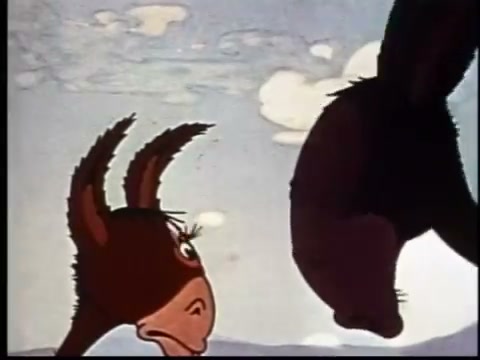
Studio: Fleischer Studios (Color Classics)
Distributor: Paramount Pictures
Produced by: Max Fleischer
Short Synopsis
Hunky, a mother burro, and her foal Spunky live free in the desert of the American Southwest. Spunky is curious and wilful and wanders off, and a prospector with a pack-mule train catches him and tries to break him to the pack, loading him with sacks and beating him when he will not move. Spunky, small and stubborn, resists every trick, and Hunky, searching for her child, arrives in time to rout the prospector with hooves and teeth and take Spunky home. The story is told almost without dialogue, with Sammy Timberg's score and the burros' brays carrying the emotion, and the desert, with its mesas and cacti, is painted with a softness unusual for the Fleischer studio.
Why It Matters
- The film was nominated for the Academy Award for Best Short Subject (Cartoons), the Fleischers' first nomination, and lost to Disney's Ferdinand the Bull; it shows the studio trying, after years of urban grotesquerie, to make a Disney-style film about animals and feeling, and succeeding well enough that Spunky became a recurring character. Lillian Friedman, who animated on it, was the first woman animator at an American studio.
- Hunky and Spunky is also a sign of the Fleischer studio's move to Florida in 1938, where its gentler, more pastoral films were made before the collapse of 1941; the series that followed Spunky was the last of the Color Classics. The film's copyright was not renewed, and it is in the public domain.
Notes and Trivia
- Spunky appeared in six more cartoons, including Always Kickin' (1939) and A Kick in Time (1940).
- The burros' names became a byword for an inseparable pair in 1930s slang.
- See also: A Kick in Time (1940), Dancing on the Moon (1935).


