
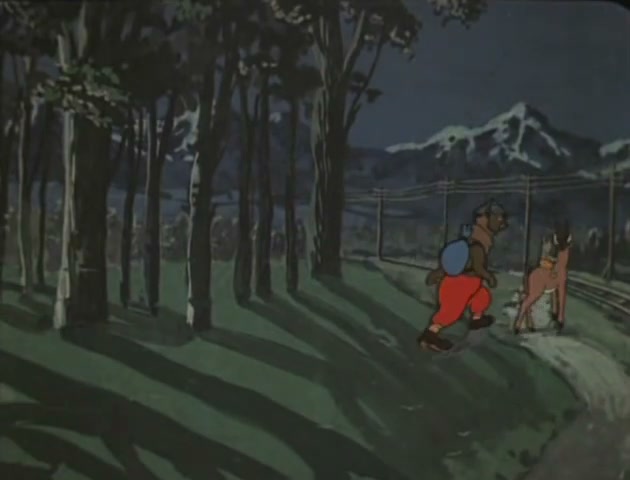
Studio: Georgian Film Studio
Short Plot Synopsis
The surviving record points to a compact mountaineering cartoon built for quick theatrical readability, but not to a richly preserved scene-by-scene synopsis. What does survive clearly is the premise promised by the title: a short comic treatment of alpine bravado, staged through a Georgian animation unit working in a ten-minute format where the climbing setup, the danger, and the punchline all have to register fast.
That thin plot trail is worth stating plainly rather than pretending otherwise. In this case the article's value comes from matching the little we can document about the film's action with the much fuller surviving production footprint around it.
Why Is It Worth Watching?
- It offers a rarer look at postwar Georgian animation, which is exactly the kind of local production history that disappears when Soviet cartoon history is told only through Moscow studios.
- The film is useful because its full crew record survives unusually well, letting you see a small animation unit as a working team rather than as a title and two names.
- Its ten-minute scale also makes it a good reminder of how much of animation history was built out of brisk supporting shorts, not only canonized features and festival landmarks.
Legacy And Impact
Audacious Mountaineers matters less because of a heavily memorialized plot than because it preserves a piece of the Soviet animation map that is otherwise easy to flatten. Animator.ru and related Soviet-animation cataloguing preserve not only the staffing but also a stable ten-minute runtime, which is more than many comparable regional shorts retain. Together those records keep Georgian Film Studio visible as something more concrete than a regional footnote: named animators, named cinematographers, a named art director, a music credit, and a workable sense of the film's scale all survive around the short.
That matters historically because smaller-studio continuity is often what vanishes first. Even when a cartoon's narrative is only lightly documented, a preserved production record can still show where work was happening, who was doing it, and how broadly Soviet animation labor was distributed outside the best-known centers. This entry earns its place by making that distributed production culture harder to ignore.
Trivia
- The animator.ru film page and linked studio entity preserve a fuller crew trail than many neighboring Soviet shorts, which makes the film especially useful for seeing how a 1950 Georgian animation unit was actually staffed.
- The preserved credit trail suggests a small local team handling several production functions at once, a reminder that postwar Soviet animation was not made only in the largest central studios.
- The ten-minute runtime survives clearly enough in the Soviet animation record to make the film's compact scale part of what is actually documented, not just inferred from the title or format.
- That runtime confidence does not extend to day-level release dating, which is why the article keeps the title at year precision rather than pretending the better-preserved production record solves every metadata gap.
- Here too the uneven metadata is intentional: runtime and crew survive better than exact release chronology.
- This entry too should now be treated as metadata-stable unless stronger release-date evidence appears.
- More specifically, it should be treated as metadata-stable at year precision unless stronger primary release documentation appears.
- A direct check of the linked Wikidata entity still only returns a year-precision release claim for 1950, which matches the article's refusal to overclaim a cleaner calendar date.
- In that sense the film matters as documentation as much as entertainment: it gives the wider Soviet animation map a more provincial and more accurate shape, and reminds you that local studio continuity can survive only through these preserved credit traces.


