
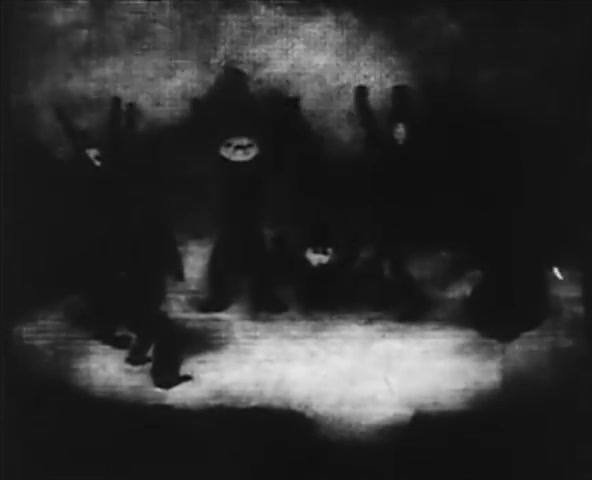
Studio: Alexandre Alexeieff and Claire Parker (independent, Paris)
Short Synopsis
To Mussorgsky's tone poem of a witches' sabbath, images rise out of darkness and dissolve back into it: a scarecrow that becomes a man, horses that become skeletons, a windmill, a church, faces, a flying witch, figures that stretch and melt into one another as the music swells and fades. There is no story beyond the music's own, the gathering of evil spirits on the mountain and their dispersal at dawn, and the images are less a narrative than a succession of apparitions, each growing from the last. They were made on the pinscreen, a board set with about half a million steel pins which Alexeieff and Parker pushed in and out with small tools and lit from the side, so that the shadows of the pins formed a grey-scale picture that could be reworked frame by frame; the film took eighteen months.
Why It Matters
- Nothing in animation looks like a pinscreen film: the images have the grain of a mezzotint engraving and the fluidity of a dream, and the shift from one form to another happens inside the texture itself rather than by drawing. Night on Bald Mountain is the first film made with the device and remains the most powerful, a true visualisation of a piece of music rather than an illustration of it.
- Alexeieff, a Russian émigré book illustrator, and Parker, an American student who became his partner and wife, invented the pinscreen in 1931 and used it for only a handful of films over fifty years, including the prologue of Orson Welles's The Trial; their technique was taken up by the National Film Board of Canada in the 1970s and is still practised by a few animators. The 1933 film is the founding work of the whole tradition.
Notes and Trivia
- Disney's Fantasia used the same music for its Chernabog sequence seven years later, with a quite different result.
- Alexeieff and Parker later made the pinscreen film Le Nez (1963), after Gogol, and advertising films to earn a living.
- See also: Fantasia (1940), Begone Dull Care (1949).


